I waited until Saturday to post this week’s Fabulous Fiction Friday post not because I forgot, but because I wanted to tell you about a book that is not related to art. Gasp.
But since we were talking about angles yesterday, I thought the story of a knight who uses angles to complete a quest would be a great choice for this week’s book.
Sir Cumference and the Great Knight of Angleland, written by Cindy Neuschwander and illustrated by Wayne Geehan, is the story of Radius and his quest to find his neighbor, King Lell. Armed with only a circular medallion (a compass), Radius travels through a cute little town full of houses whose roofs connect at small angles. He then makes his way through the mountains of Obtuse. Finally, he must solve a series of angle-related challenges to make his way through the castle to rescue King Lell.
This book is full of math puns (which I love), and even includes two dragons that belong to King Lell (the “pair of Lell’s”).
This is a fun story and a great introduction to angles.
Return to main page.
Showing posts with label math. Show all posts
Showing posts with label math. Show all posts
Saturday, February 7, 2009

Thursday, February 5, 2009
Art Angles
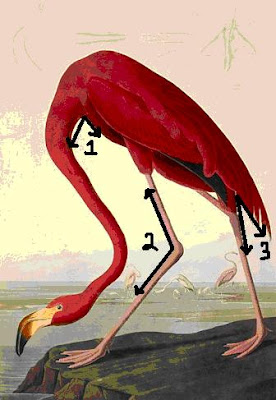
I've been working on a lesson plan for one of my classes and I thought you might be interested in some of the materials I've been preparing. The lesson is meant to teach 3rd graders to indentify right angles, acute angles, and obtuse angles. One of the activities I've been readying is a set of note cards with pictures on them. In the pictures, I've traced some of the angles and numbered them. The students are to tell whether each angle is right, acute, or obtuse. They are then to label each angle ABC. My note cards will be laminated so the students can label them and then erase them. This means I'll be able to reuse them.
Some of my images are photographs of objects like trees, fenses, and planes. Some, of course, are pictures of artwork. The artwork is below. If you want to use the images, copy them into a word document and resize them so they fit on note cards.
In order: 1. John James Audubon's Flamingo, 2. Pierre-Auguste Renoir's Girls at the Piano, 3. Henri Matisse's Jazz, 4. a Greco-Roman bronze sculpture called Boy with Thorn, 5. Gustave Courbet's Cliffs Near Etretat, 6. an Egyptian sculpture of Akhenaten, 7. Andre Derain's The Turning Road, 8. and a color field painting by Piet Mondrian.
Enjoy!


Saturday, November 29, 2008
Math Curse by Jon Scieszka and Lane Smith
What is this? A bonus post? Hmmm.
Happy Saturday. Saturdays are reserved for those rare times when I want to say something that has nothing to do with art.
I want to recommend a great book by Jon Scieszka and Lane Smith called Math Curse. A boy’s teacher, Mrs. Fibonacci, suggests that “you can think of almost everything as a math problem.” When the boy wakes up the next morning, math is all around him. It’s in his morning routine, it’s at lunch, it’s in social studies, English, and P.E. classes. The boy just can’t escape the math curse!
There are references to math concepts that students won’t learn until middle school or high school but they’re subtle. For instance, though the math teacher’s name is Mrs. Fibonacci, it doesn’t matter that a third grader wouldn’t know what the Fibonacci Sequence is. I think this would be a great book to read to upper-elementary-level math students on the first day of class.
There is another book in this series, Science Verse, that I do not recommend for young students. Unlike Math Curse, when reading Science Verse it is important to understand the upper-level science concepts to find enjoyment in the book. If you read Science Verse to elementary school students, you would have to spend a lot of time explaining ideas.
Enjoy the rest of your weekend!
Return to main page.
___________________________
My Current NaNoWriMo Word Count:
56140 / 60000 words. 94% done!
One more day to go!
Happy Saturday. Saturdays are reserved for those rare times when I want to say something that has nothing to do with art.
I want to recommend a great book by Jon Scieszka and Lane Smith called Math Curse. A boy’s teacher, Mrs. Fibonacci, suggests that “you can think of almost everything as a math problem.” When the boy wakes up the next morning, math is all around him. It’s in his morning routine, it’s at lunch, it’s in social studies, English, and P.E. classes. The boy just can’t escape the math curse!
There are references to math concepts that students won’t learn until middle school or high school but they’re subtle. For instance, though the math teacher’s name is Mrs. Fibonacci, it doesn’t matter that a third grader wouldn’t know what the Fibonacci Sequence is. I think this would be a great book to read to upper-elementary-level math students on the first day of class.
There is another book in this series, Science Verse, that I do not recommend for young students. Unlike Math Curse, when reading Science Verse it is important to understand the upper-level science concepts to find enjoyment in the book. If you read Science Verse to elementary school students, you would have to spend a lot of time explaining ideas.
Enjoy the rest of your weekend!
Return to main page.
___________________________
My Current NaNoWriMo Word Count:
One more day to go!
Sunday, July 6, 2008
Kandinsky Geometry
I have already written about Wassily Kandinsky, a Russian, abstract artist. For a class I’m taking, I have been working on a geometry lesson using one of his paintings. I thought some of you might find it useful. In my opinion, any time you can incorporate art into math or reading—or any subject—it’s a good thing.
The purpose of the activity is for kids to learn to measure diameter, radius, and circumference of a circle. This activity is good for 3rd and 4th graders.
Materials Needed:
Kandinsky’s Circles in a Circle
Ruler
Pencil
Yarn
Focus first on the inside of the large, black circle.
Diameter is the measurement of the length across a circle. To find the diameter, use a ruler to measure straight across the circle. This line should cut the circle exactly in half.
Radius is the measurement from any point on the edge of the circle to the center. It would not be easy to guess the exact middle of the circle so, to find radius, divide the diameter in half. If you don’t yet know how to divide, try using a paper ruler that you can fold. Find the diameter and then fold the ruler so the diameter is split in two equal parts. The fold will tell you the radius.
Circumference is the measure around the circle. To find circumference, use a piece of yarn to find the length around the outside edge of the circle. Then, use your ruler to measure the yarn.
Repeat these steps until you are a master of measuring diameter, radius, and circumference.
A related project can be found here.
Return to main page.
The purpose of the activity is for kids to learn to measure diameter, radius, and circumference of a circle. This activity is good for 3rd and 4th graders.
Materials Needed:
Kandinsky’s Circles in a Circle
Ruler
Pencil
Yarn
Focus first on the inside of the large, black circle.
Diameter is the measurement of the length across a circle. To find the diameter, use a ruler to measure straight across the circle. This line should cut the circle exactly in half.
Radius is the measurement from any point on the edge of the circle to the center. It would not be easy to guess the exact middle of the circle so, to find radius, divide the diameter in half. If you don’t yet know how to divide, try using a paper ruler that you can fold. Find the diameter and then fold the ruler so the diameter is split in two equal parts. The fold will tell you the radius.
Circumference is the measure around the circle. To find circumference, use a piece of yarn to find the length around the outside edge of the circle. Then, use your ruler to measure the yarn.
Repeat these steps until you are a master of measuring diameter, radius, and circumference.
A related project can be found here.
Return to main page.
Subscribe to:
Posts (Atom)