In December you learned about Piet Mondrian. Mondrian’s art became more abstract over time until his paintings contained only lines and rectangles of five colors: black, white, red, blue, and yellow. I recommend that you reread that post to refresh your memory before continuing with this project.
 Also in December, I posted a Mondrian-inspired painting project. The project I am sharing with you today is much simpler. It’s also not nearly as messy and requires fewer supplies. I’m pleased with how my artwork came out and I think you’ll have good results, too.
Supplies Needed:
Construction Paper: Black, White, Red, Yellow, Blue
Glue Stick
Scissors
Gather your materials. You will use a full sheet of black and less than one sheet each of the other colors.
Do not cut your sheet of black construction paper. It will be the background of your artwork and will form the black lines between colors. Cut various sized rectangles, strips, and squares of white, red, yellow, and blue.
Lay your colors onto your black paper. If necessary, cut the rectangles so they fit onto the paper. Play with the rectangles until you like the look of your artwork.
To complete your artwork, use your glue stick to attach the rectangles to the black paper.
This is a great project to do with a group of kids. It is not too difficult or time consuming, and each child will create a unique piece.
Don’t forget to check out my post on De Stijl, the art movement to which Piet Mondrian belonged.
You may also be interested to create your own edible Mondrian painting.
Return to main page.
Also in December, I posted a Mondrian-inspired painting project. The project I am sharing with you today is much simpler. It’s also not nearly as messy and requires fewer supplies. I’m pleased with how my artwork came out and I think you’ll have good results, too.Supplies Needed:
Construction Paper: Black, White, Red, Yellow, Blue
Glue Stick
Scissors
Gather your materials. You will use a full sheet of black and less than one sheet each of the other colors.
Do not cut your sheet of black construction paper. It will be the background of your artwork and will form the black lines between colors. Cut various sized rectangles, strips, and squares of white, red, yellow, and blue.
Lay your colors onto your black paper. If necessary, cut the rectangles so they fit onto the paper. Play with the rectangles until you like the look of your artwork.
To complete your artwork, use your glue stick to attach the rectangles to the black paper.
This is a great project to do with a group of kids. It is not too difficult or time consuming, and each child will create a unique piece.
Don’t forget to check out my post on De Stijl, the art movement to which Piet Mondrian belonged.
You may also be interested to create your own edible Mondrian painting.
Return to main page.

 Mondrian soon became interested in cubism. Cubism, which I have not yet posted about, is an artistic style in which the subject is broken into meaningful pieces and rearranged in a new order to show the most important parts of the object. The painting shown below, Still Life with Ginger Pot, was painted by Mondrian in the cubist style. Because of the influence of cubism, Mondrian’s paintings became more and more abstract. Mondrian moved to Paris in 1912 so he could further study cubism.
 In 1914 Mondrian returned home just before World War I broke out. He was stuck there for the duration of the war (1914-1919). During this time he became friends with some other artists and together they began the new movement,
 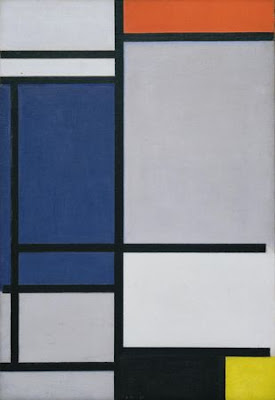 The members of the De Stijl movement were searching to paint an even more honest truth than the cubists. They believed the essence, the foundation of all things could be found in the simplest form: straight lines and primary colors. So Mondrian began painting pieces like the one shown above, Composition.
 These ideas were used not only in paintings, but in architecture as well. Look at this house, for instance, designed by Gerrit Rietveld. It is completely black and white with details in primary colors, and uses only rectangles formed by horizontal and vertical lines. The inside also uses simple lines. If you’ve ever seen a Frank Lloyd Wright designed building, you may be thinking that this house reminds you of his work. You’d be right to think that because Wright’s designs from the 1900s and 1910s influenced the later work of these Dutch architects. (You’ll learn about Wright next week.)