I found a great cubism project that you might like. It looks like a fun, simple project to do with a group of kids. Create a Cubist Fall Tree.
Also, I added a link to the list in my sidebar but I forgot to tell you that I had done so. In case you haven't already found it, Jenny at Little Acorns has put together a 36-week art curriculum for her daughters. She has obviously put a lot of effort into it and it is fantastic. She has posted it free on her website. I hope some of you will use it this year. I look forward to reading about Jenny and her daughters' art explorations!
Return to main page.
Showing posts with label cubism. Show all posts
Showing posts with label cubism. Show all posts
Wednesday, September 3, 2008

Tuesday, September 2, 2008
Create Your Own Cubist Photo Collage
If you missed yesterday’s post about cubism, go read it before you try this project. Cubists took everyday objects and (in their minds) took them apart and explored the pieces. Then they put those objects back together in a new way. In this way, cubists were able to show many sides of the same object at the same time.
 Supplies Needed:
Digital Camera
Printer
Paper
Construction Paper
Glue Stick
Scissors
Make sure you have permission from a grown-up before you start. If you don’t have a digital camera, try drawing your object from several angles instead of photographing it.
Take pictures of an object from many angles. I choose to photograph a tree. The great thing about digital cameras is that you can take as many pictures as you want and choose which to use later. I think I took 30 pictures of my tree but I only used 5 of the pictures.
Print out about five or six pictures. Regular computer paper will work better than photo paper for this project. I printed three pictures in grayscale (black and white) and two pictures in color. You can decide for yourself if you want your collage to be completely black and white, complete color, or a combination.
Cut your pictures into pieces. I really wanted to use the trunk and branches so I cut those out first. Also, I got a picture with the sun shining over the tree. I knew I wanted to use that, too.
Once you have arranged the major pieces of your collage, begin to fill in the rest. For me, that meant adding leaves.
When you’re pleased with your collage, glue everything down.
Just like the cubists, you may find that your collage is more than just a picture of the object you started with.
Return to main page.
Supplies Needed:Digital Camera
Printer
Paper
Construction Paper
Glue Stick
Scissors
Make sure you have permission from a grown-up before you start. If you don’t have a digital camera, try drawing your object from several angles instead of photographing it.
Take pictures of an object from many angles. I choose to photograph a tree. The great thing about digital cameras is that you can take as many pictures as you want and choose which to use later. I think I took 30 pictures of my tree but I only used 5 of the pictures.
Print out about five or six pictures. Regular computer paper will work better than photo paper for this project. I printed three pictures in grayscale (black and white) and two pictures in color. You can decide for yourself if you want your collage to be completely black and white, complete color, or a combination.
Cut your pictures into pieces. I really wanted to use the trunk and branches so I cut those out first. Also, I got a picture with the sun shining over the tree. I knew I wanted to use that, too.
Once you have arranged the major pieces of your collage, begin to fill in the rest. For me, that meant adding leaves.
When you’re pleased with your collage, glue everything down.
Just like the cubists, you may find that your collage is more than just a picture of the object you started with.
Return to main page.
Monday, September 1, 2008
Cubism
In the early 1900s, some artists became interested in African and Native American art. The styles of those cultures inspired cubism.
Cubism began in France in 1907. Pablo Picasso and George Braque began painting figures that were made up of cubes, spheres, cylinders, cones, and other geometric shapes. The paintings looked like someone had cut them up and glued them back together.
Cubism began in France in 1907. Pablo Picasso and George Braque began painting figures that were made up of cubes, spheres, cylinders, cones, and other geometric shapes. The paintings looked like someone had cut them up and glued them back together.

And that’s exactly what the cubists had in mind. Just like the ancient Egyptians, cubists wanted to show the most important parts of the things they painted. Look at the face in Juan Gris' Portrait of Picasso (above). Gris shows you every detail of Picasso's face even though you would never be able to see all sides of his face at the same time. The cubists took this idea much further than the ancient Egyptians, of course. Cubists wanted to show all the sides of an object in the same picture.
 Some cubist paintings were extremely abstract. In Picasso’s The Guitar Player (above), it is difficult to see the person in the painting.
At first, cubists used very little color in their paintings. They used mostly browns, greys, and blues. In 1912, color re-entered the picture and some artists, like Picasso, began using more then just paint and canvas in their art. You may remember reading about Picasso’s musical collages in which he used paper and cloth in his paintings.
Return to main page.
Tuesday, May 6, 2008
Diego Rivera
Diego Rivera and his twin brother, Carlos, were born in 1886 in the mountains of Mexico. Rivera’s parents helped poor people live better lives. This helped shaped the way Rivera painted.
Rivera began to draw when he was only three years old. He drew on everything: floors, furniture, walls, and paper. He loved to draw huge pictures on walls (murals) so his parents covered his bedroom walls with paper.
When he was 10, Rivera began to use paints. He took art classes after school. It wasn’t long before he decided to become a painter.
Rivera studied art at the San Carlos School of Fine Arts where he learned about the art of the Mexican Indians. He loved their paintings of people at work and Rivera began painting similar subjects. Rivera also learned from a teacher who enjoyed painting the differences between rich people and poor people.
He then went to study in Europe, first in Spain, then Paris. He made friends with many important artists. At this time, cubism was a growing style. Rivera painted some cubist paintings (such as Portrait of Martin Luis Guzman, shown below) before moving toward a post-impressionistic style. He began to paint large, simple shapes and used bold colors. He developed his own style while he was in Paris and his paintings started to attract attention. Rivera’s paintings were very popular and sold well. Check out Flower Festival for an example. Notice the difference between that painting and the one shown below.
 In 1922, Rivera married his first wife, Guadalupe Marin. She was a model and a novelist. The marriage didn’t last and in 1929 Rivera married Frida Kahlo. She was also an artist. I’ll post about her tomorrow. When Kahlo died, Rivera married a third time. His final wife was Emma Hurtado, his agent (the person who sold his paintings).
Rivera became famous for his large frescoes. He liked creating art that would be seen by many people; murals were the perfect form. He painted 27 murals for the Detroit Institute of Arts. He also painted murals in New York City, San Francisco, and Mexico.
In 1955 Rivera fell ill. He died in 1956.
Go to Olga's Gallery to view more of Rivera's paintings.
Return to main page.
Friday, March 14, 2008
Andre Derain
Andre Derain was such a star during most of his life but I would guess that many of you hadn’t heard of him before yesterday’s post on fauvism. After today, all that will be changed!
Andre Derain was born in 1880 just outside of Paris to a pastry chef. He was a terrible student but he was great at drawing and, when he was fifteen, began painting lessons. It was because of these lessons that Derain met Henri Matisse who would also become a fauvist.
In 1900, Derain and his new friend, Maurice de Vlaminck, rented an old restaurant to use as a studio. During this time Derain studied the works of the masters that hung in the Louvre and he visited new exhibits to keep up to date on the happenings in the art world. He was called into military service at the end of 1900 but before he left he introduced Vlaminck and Matisse, thus paving the way for fauvism.
When he returned from the service in 1904, Derain’s career began to pick up. A wealthy art collector bought all the paintings in his studio in 1905, then Derain showed at the Salon des Independants where he sold four paintings. Later that year he showed at the Salon d’Automne where the fauvist movement got its name. (Shown below is Collioure.)
 In 1906, the art collector who had bought out Derain’s studio wanted more paintings. Derain went to London to create these paintings which became some his most popular and most famous. Below is London Bridge, one of thirty paintings Dearain completed in London.
 Late in 1906, Derain met Picasso. This friendship would last for many years and Picasso would influence Derain to experiment with cubism (like in the painting shown below, Cubist Grove, which is cubist more in color than in overall style) as the fauvists began to move on to other styles.
 Derain illustrated two books around this time, one by Guillaume Apollinaire and a book of poetry by Max Jacob.
Around 1911, Derain’s work began to show the influence of the old masters he had studied at the Louvre. In 1914 he was again called into military service. When he finished his duty in 1919 he continued to develop in this more classical style. Below is Portrait of a Young Girl in Black, an early example of Derain's later style.
 Derain became even more popular and he was thought highly of throughout the art world and beyond. In the year leading up to World War II, however, Derain’s downfall began. Hitler’s foreign minister wanted Derain to paint a family portrait. Derain did not paint the portrait but he did go to Germany on an official visit. This was not a popular thing to have done and after the war Derain could never regain his position in the art world. Several negative books were published about him during his lifetime which made him unsure about his work. He couldn’t create the way he used to.
He lived his final year with an eye infection and was then killed by a car in 1954.
Return to main page.
________________________________________
Current NaNoEdMo Hour Count: 13.5/50hours
Yeah. I'm not doing so well with this but those 13.5 hours have made a huge difference.
Andre Derain was born in 1880 just outside of Paris to a pastry chef. He was a terrible student but he was great at drawing and, when he was fifteen, began painting lessons. It was because of these lessons that Derain met Henri Matisse who would also become a fauvist.
In 1900, Derain and his new friend, Maurice de Vlaminck, rented an old restaurant to use as a studio. During this time Derain studied the works of the masters that hung in the Louvre and he visited new exhibits to keep up to date on the happenings in the art world. He was called into military service at the end of 1900 but before he left he introduced Vlaminck and Matisse, thus paving the way for fauvism.
When he returned from the service in 1904, Derain’s career began to pick up. A wealthy art collector bought all the paintings in his studio in 1905, then Derain showed at the Salon des Independants where he sold four paintings. Later that year he showed at the Salon d’Automne where the fauvist movement got its name. (Shown below is Collioure.)
In 1906, the art collector who had bought out Derain’s studio wanted more paintings. Derain went to London to create these paintings which became some his most popular and most famous. Below is London Bridge, one of thirty paintings Dearain completed in London.Late in 1906, Derain met Picasso. This friendship would last for many years and Picasso would influence Derain to experiment with cubism (like in the painting shown below, Cubist Grove, which is cubist more in color than in overall style) as the fauvists began to move on to other styles.Derain illustrated two books around this time, one by Guillaume Apollinaire and a book of poetry by Max Jacob.Around 1911, Derain’s work began to show the influence of the old masters he had studied at the Louvre. In 1914 he was again called into military service. When he finished his duty in 1919 he continued to develop in this more classical style. Below is Portrait of a Young Girl in Black, an early example of Derain's later style.
Derain became even more popular and he was thought highly of throughout the art world and beyond. In the year leading up to World War II, however, Derain’s downfall began. Hitler’s foreign minister wanted Derain to paint a family portrait. Derain did not paint the portrait but he did go to Germany on an official visit. This was not a popular thing to have done and after the war Derain could never regain his position in the art world. Several negative books were published about him during his lifetime which made him unsure about his work. He couldn’t create the way he used to.He lived his final year with an eye infection and was then killed by a car in 1954.
Return to main page.
________________________________________
Current NaNoEdMo Hour Count: 13.5/50hours
Yeah. I'm not doing so well with this but those 13.5 hours have made a huge difference.
Wednesday, December 12, 2007
Piet Mondrian
Piet Mondrian was born in the Netherlands in 1872. He was influenced by many artistic styles and even helped found an artistic movement called De Stijl. He died in 1944, have created about 250 paintings in his lifetime.
The paintings that Piet Mondrian is most famous for are rectangles of white and primary colors, dissected by black lines. He did not always paint this way, however. Mondrian’s first paintings depicted scenes found in real life. They were done in a style similar to impressionism. As his style grew and changed, he stopped using any colors besides the three primaries: red, yellow, and blue. The painting shown below is Avond. This is the first painting in which Mondrian used only primary colors but you can still see the influence of impressionism.
The paintings that Piet Mondrian is most famous for are rectangles of white and primary colors, dissected by black lines. He did not always paint this way, however. Mondrian’s first paintings depicted scenes found in real life. They were done in a style similar to impressionism. As his style grew and changed, he stopped using any colors besides the three primaries: red, yellow, and blue. The painting shown below is Avond. This is the first painting in which Mondrian used only primary colors but you can still see the influence of impressionism.
 Mondrian soon became interested in cubism. Cubism, which I have not yet posted about, is an artistic style in which the subject is broken into meaningful pieces and rearranged in a new order to show the most important parts of the object. The painting shown below, Still Life with Ginger Pot, was painted by Mondrian in the cubist style. Because of the influence of cubism, Mondrian’s paintings became more and more abstract. Mondrian moved to Paris in 1912 so he could further study cubism.
 In 1914 Mondrian returned home just before World War I broke out. He was stuck there for the duration of the war (1914-1919). During this time he became friends with some other artists and together they began the new movement, De Stijl, which I posted about yesterday. The movement was called De Stijl because that was the name of the journal that Mondrian and his friends started. They called the movement neoplasticism and today both names are correct.
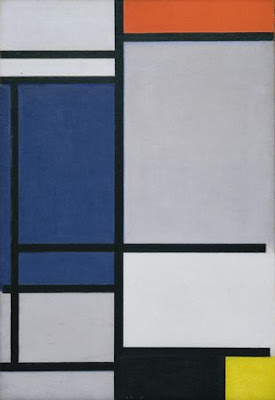 The members of the De Stijl movement were searching to paint an even more honest truth than the cubists. They believed the essence, the foundation of all things could be found in the simplest form: straight lines and primary colors. So Mondrian began painting pieces like the one shown above, Composition.
Tomorrow I’ll teach you to make your own Mondrian-inspired painting.
EDITED TO ADD: Create Your Own Edible Mondrian Painting,
Create Your Own Mondrian Masterpiece
Subscribe to:
Posts (Atom)