skip to main |
skip to sidebar
Morris Louis created his paintings a little differently, but you can create your own stripe paintings like his.
Supplies Needed:
Cookie Sheet
Heavy Paper
Washable Paints
Paintbrush
Spray Bottle
Tape Paper Towels
This project is a lot of fun, but it can get messy. Make sure you cover your work space and have paper towels handy.
Use a small piece of tape to attach your paper to the cookie sheet.
Dab blobs of different colored paint in a line across the top of your paper. You don’t need a lot of paint to create stripes.
 Set your spray bottle to a wide spray. Water should mist out of the bottle. Angle your bottle downward and spray the paint blobs until they begin to run. Continue to spray until most of the paint has run down the page.
 Use a paper towel to catch the extra water. You may also want to use a paper towel to blot the bottom of your paper.
Voila! Your very own stripe painting!
Tomorrow I’ll show you how to use this technique to make fun, homemade Christmas cards.
Return to main page.
Morris Louis was born in Baltimore, Maryland in 1912. His name was Morris Louis Bernstein but he dropped the Bernstein in the late 1930s. He studied art at the Maryland Institute of Fine and Applied Arts but he left school before finishing the program.
He went to New York in 1936. Louis helped with some workshops that helped artists use unusual tools, like spray guns, to create art. These workshops helped grow the Abstract Expressionist movement.
Louis didn’t stay in New York for long. In 1940 he moved back to Baltimore and began showing his work. A group of local artists liked his work and convinced him to teach them.
Louis moved to Washington, D.C. in 1952 and started teaching at the Washington Workshop Center of the Arts. He didn’t have many friends in the art world and didn’t travel much to learn about new styles of painting. While in D.C., Louis met artist Kenneth Noland. Noland took Louis to New York where he saw the work of many new artists. One artist, Helen Frankenthaler, really inspired Louis. This painting, Mountains and Sea, especially moved him. Frankenthaler had stained the canvas rather than just painting it. Louis would try this method when he returned to D.C.
Louis began a series of paintings that he called Veils. To create his Veils, Louis poured paint onto a canvas and then poured thin black paint over the colors. Check out this Veil painting.
When he had finished his Veil paintings, Louis didn’t know what to paint next. He wasn’t happy with anything he created and he destroyed about 300 paintings.
Finally, in 1960, Louis began painting another series, called Unfurleds. In these paintings, Louis painted stripes of bright color that began in the upper corners and met at the bottom center in a V-shape. This is a great example on an Unfurled painting.
Morris Louis created one more famous series of paintings, called Stripes. The Stripes paintings featured slightly overlapping stripes of bright colors that began part way down the canvas and ran off the bottom. Louis’ Stripe paintings are my favorites. Check out this one and this one.
Louis died in 1962.
Tomorrow: A Morris Louis project.
Return to main page.
The first color field painter I’ll post about is Mark Rothko. Rothko did not begin as a color field painter but he his best known for the paintings he did in this style.
Rothko was born in Russia in 1903. He and his family moved to Oregon when he was 10 years old. They struggled for money. Rothko did well in school and earned a scholarship to Yale University. He thought he would become an engineer or an attorney—careers at which he would make some money. In 1923, his second year of college, Rothko left Yale.
He moved to New York City and became involved with some artists. He began taking classes at the New School of Design. Arshile Gorky, whom I wrote about earlier, was one of Rothko’s teachers.
Rothko’s early paintings were somewhat realistic. They showed some recognizable objects such as people, buildings, and landscapes. (For an example click here.)
In the 1940s Rothko became interested in using mythology in his paintings. He thought he could best paint emotion by showing known creatures from myths. These mythological paintings were similar in style to Surrealist paintings. (For example: The Syrian Bull.) It didn’t take long for Rothko to decide that mythology was outdated. He began to believe that too many artists had already used myths in their paintings. He was also convinced that painting myths wasn’t the best way to show emotion in his art.
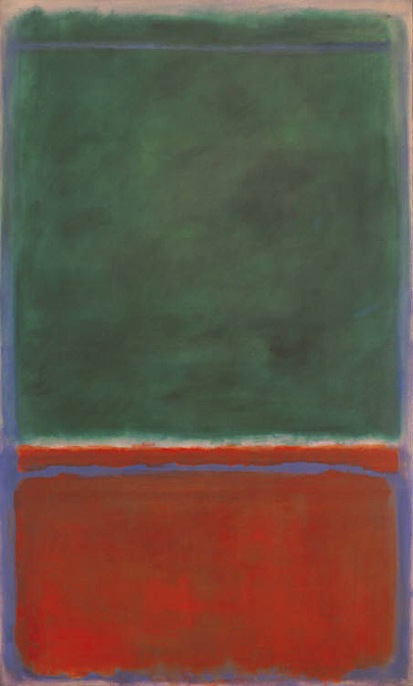
Mark Rothko’s art became more abstract at the end of the 1940s. He decided that simple shapes were the best for showing complicated feelings. The large, simple shapes allow you to feel instead of think when you look at Rothko’s paintings. (Examples: here, here.)
His later paintings, those from 1948 and later, show only two, three, or four rectangles lined up one of top of the other (vertically). He painted these color field paintings on huge canvases because he wanted the viewer to get lost in the painting. He didn’t want you to stand back from his paintings and look on. He wanted you, instead, to stand close and become a part of the artwork. He wanted you to feel the emotion he had painted. (For images click here, here.)
Beginning in the late 1950s, Rothko used much darker colors. He overlapped colors until the canvas was covered with deep reds, blues, blacks. He was painting sadder, angrier moods than before. (For images click here, here.)
Rothko died in 1970.
Return to main page.
My trip to Massachusetts was a lot of fun but tiring. I got a sore throat on the way home and by this morning it was killer. I'm feeling much better tonight, though! I hope you all had a good weekend, too.Today, I thought I’d say something about color field painting. I plan to post about some color field painters this week.
Color field painting is a type of abstract expressionism that began in the U.S. in the 1950s. Color field artists did not paint recognizable objects. Like some other abstract artists you've read about, they were trying to paint emotion onto canvas. Color field painters also aimed to create more organized, rational, and ordered art. They did this by painting large canvases with solid, geometrical shapes of bright color.
There were, of course, color field painters who didn’t use geometrical shapes. There were also those who painted vibrant shapes but who, instead of filling them in with solid colors, used many colors to outline them. There are always exceptions to rules, especially in the art world. Once you’ve learned about some of these artists it will be clear to you what links them together under the style of color field painting.
Return to main page.
Wassily Kandinsky was born in Moscow in 1866. He studied economics and law at the University of Moscow before becoming a professor. He was 30 before he went to Munich, Germany and began to truly study art. He focused, at first, on creating sketches and studies of human bodies. He settled in Germany after World War I where he taught art at the Bauhaus school and painted until the Nazis came into power. At that point (1933), he went back to France where he remained for the rest of his life.
On a somewhat-side note, the Nazis took some of Kandinsky’s paintings, displayed them in a collection of art they deemed inappropriate and unworthy, and then destroyed the paintings. The exhibition was called “Degenerate Art.” I will post more about this tomorrow.
Kandinsky’s earliest paintings were quite realistic. Then he moved into a style similar to that of the Impressionists before he began creating completely abstract paintings. Yesterday I used Monet’s Water Lilies to show this movement toward the abstract. Today, you can see that Kandinsky developed the same way except that Kandinsky became a truly abstract artist in the end. Check out Olga’s Kandinsky Gallery for pictures. All (or at least most) of his works are posted there in order. As you click through the pages, you can clearly see Kandinsky’s work become more and more abstract.
Kandinsky was especially interested in color, even as a child. Beginning in his earlier, more realistic paintings, Kandinsky used color to show emotion rather than to make objects look real. As he grew as an artist, Kandinsky became more concerned with the power of color in describing what he was feeling. He wanted to use color to make his viewers feel emotion, too.
Gradually, Kandinsky became more abstract. He began to paint objects as patches of color instead of painting perfect details such as facial features or individual leaves on trees. Remember that Kandinsky studied the human body and knew how to paint people well. He liked the abstract more than the realistic. As he grew as an artist, his figures became less realistic until the viewer could no longer identify known objects in his paintings.
Kandinsky was trying to create the same effect on a viewer of his paintings as a beautiful piece of music has on a listener. When you listen to Vivaldi’s Four Seasons, for example, you don’t see snow or swirling fall leaves, or a muddy spring garden after a rain storm. You feel the seasons happening but you don’t actually see them. This is what Kandinsky was trying to do in his paintings.
Kandinsky’s ideas about art are possibly more important than even the paintings he created. He wrote three books about his ideas.
There are two Kandinsky projects posted at Art Projects for Kids. They both look pretty good but I’ve only tried this one, not this one. If you do either of the projects, please comment about your experience. I would love to hear about it and other readers would benefit from your comments as well. Happy creating!
EDITED TO ADD: Practice Geometry Using Kandinky's Art
Return to main page.
Beginning with the Impressionists at the end of the 1800s, art began to shift from realistic images to abstract images. In other words, artists became less concerned with painting a landscape and more concerned with the emotions a painting could stir in the viewer.
An excellent example of this development is Claude Monet’s Water Lilies series. In his first paintings of water lilies, Monet takes care to create realistic, recognizable lilies floating on a pond. By the end of his life, the lilies are hardly more than green smudges on a blue background, but the effect of the paintings (in my opinion) remains powerful. The first image is an early painting and the second is a late example of Monet's Water Lilies 
 I would not claim that Monet was an abstract artist. This is just meant to illustrate the process of moving from art that shows recognizable subjects to art that does not.
An abstract artist whom you’ve read about already was Jackson Pollock. There are no fruit bowls in his splatter paintings. No stiffly posed women or shimmering ponds. He meant to do something more than record scenes. He meant to record emotion. Pollock looked inward at the chaos in his mind and laid it out on massive canvases so that we could feel what he felt.
In the next few days I’ll post about some other abstract artists. For now though, look back on my posts about Piet Mondrian and Pablo Picasso.
Please note that the term “abstract art” is very general. Cubism is a form of abstract art, as is neoplasticism (the movement Mondrian painted in), and many others.
Return to main page.